
Protein in Trockenmasse
bis 48,2 %Upper published value in dried Wolffia biomass.2015 · published analysisWolffia globosa
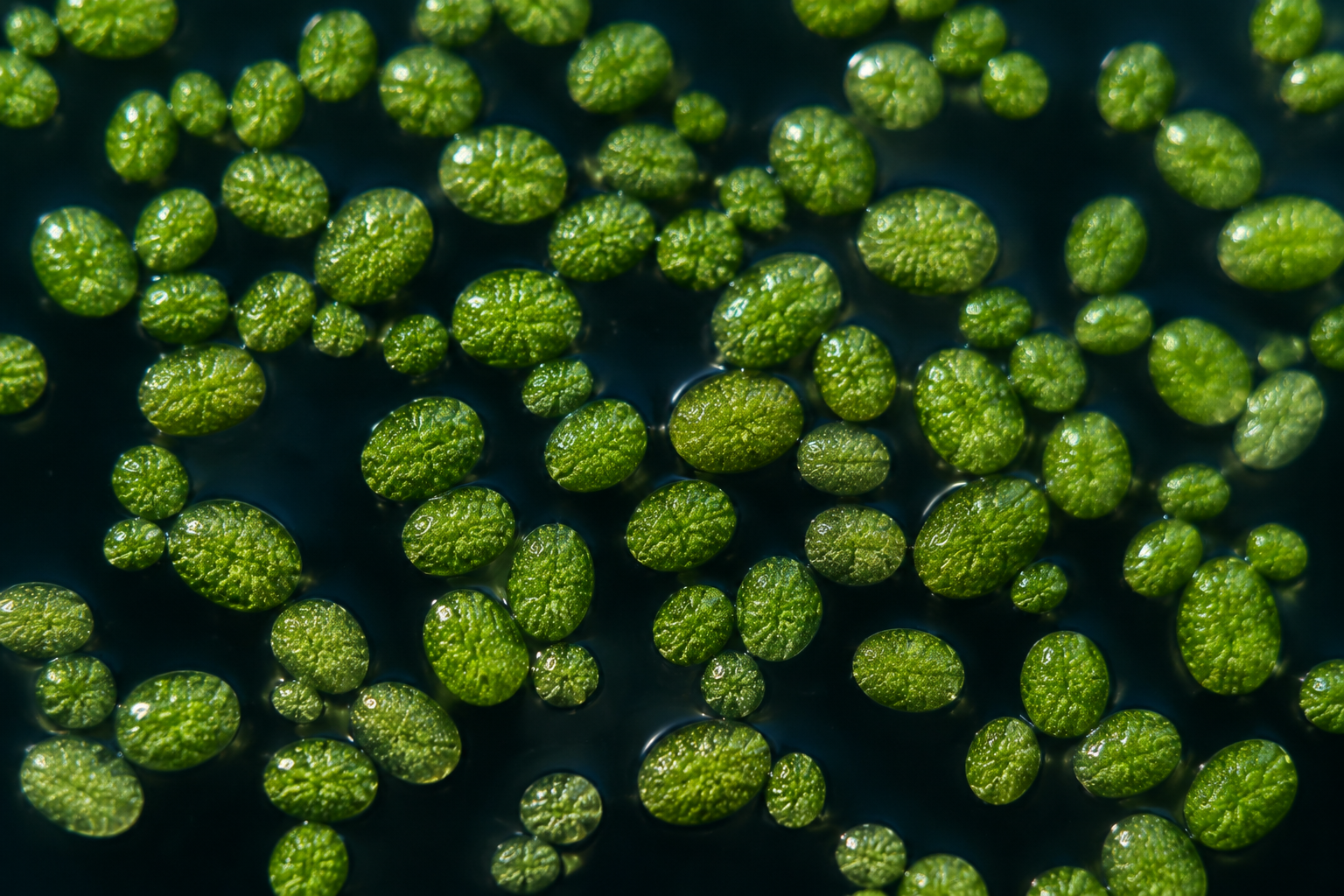
The world's smallest known
flowering plant.
Barely a millimetre long. Rootless. Free-floating. Remarkably fast-growing.
0,4–0,8 mm
Scientific · Resource-efficient · Future-oriented
Botanical scale
A millimetre
becomes a world.
00,4–0,8 mm12 mm
Biology
Float.
Grow.
Filter.
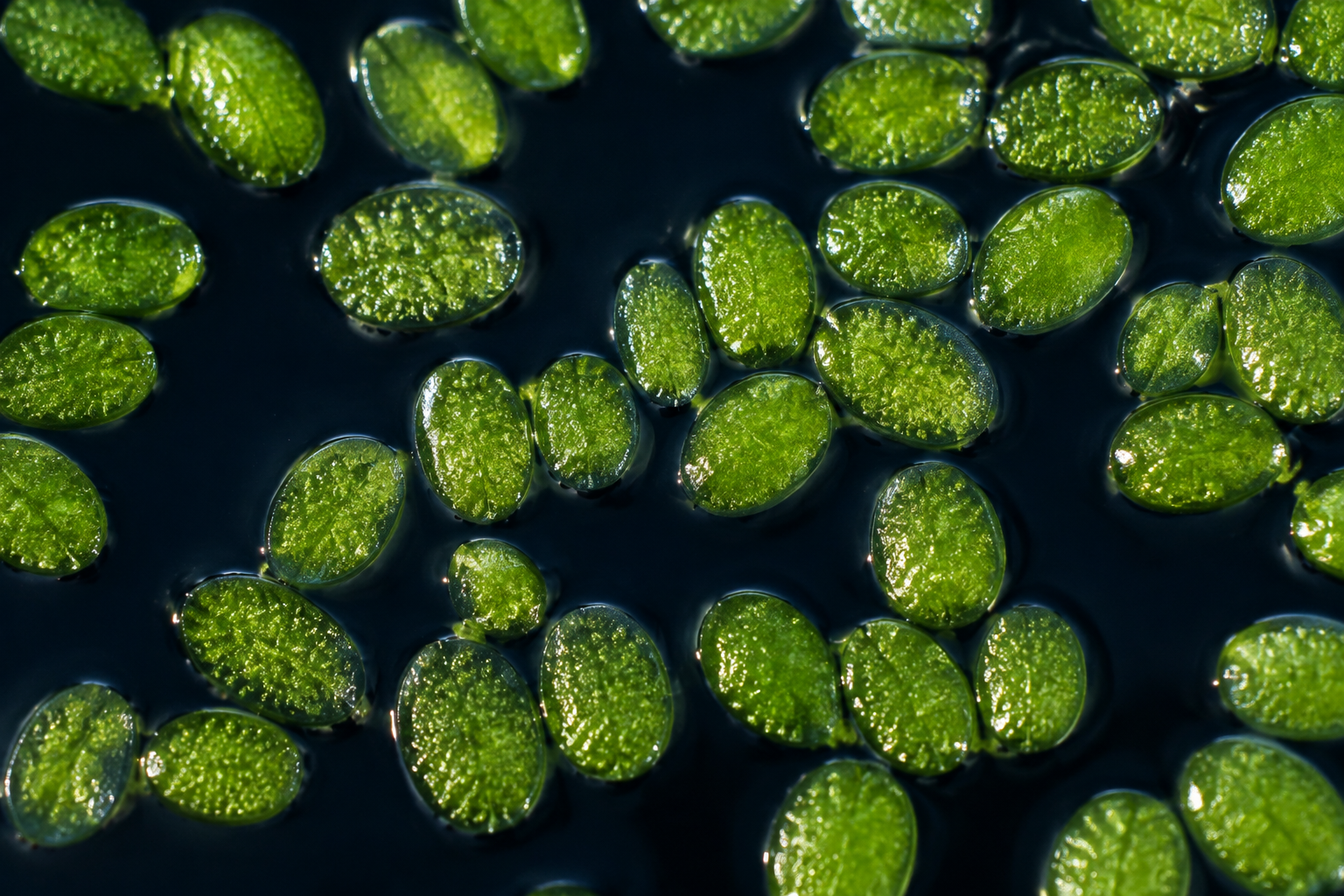
Wolffia floats freely at the water surface. Under suitable conditions, its biomass may double within a few days and can be harvested by filtration.
What looks like a tiny green oval is a complete, highly reduced flowering plant. It has no roots and reproduces mainly by budding off daughter plants.
Analytical composition
What has been measured in Wolffia?
Selected published values, shown with their study context and analytical scope.
Dietary fibre
27,7–35,3 gPublished value from analysed Wolffia biomass.2021 · published analysisAlpha-Linolensäure (Omega-3)
durchschn. ca. 3,9 gMean value per 100 g dried biomass.2021 · published analysisVerhältnis Omega-6 zu Omega-3
0,66–0,94 : 1Ratio measured in four Wolffia globosa clones.2018 · published analysisVitamin B12
bis ca. 3,62 µgUpper analysed value per 100 g dry matter.2020 · published analysisCalcium
bis ca. 2.520 mgValue per 100 g dry matter from controlled clones.2018 · published analysisThese are literature values. Wolffia composition may vary with genetics, cultivation conditions, nutrient medium, harvest and processing. The highest figures were not necessarily measured in the same sample.
B12
Understanding vitamin B12
A remarkable analytical finding.
Several biologically active forms of vitamin B12 were identified in samples from a controlled Wolffia globosa strain. These are forms the human body can, in principle, use. An accompanying human study also indicated that the B12 was absorbed.
No pseudo-B12 was detected in the Wolffia samples examined. Pseudo-B12 resembles the vitamin but cannot be used by the human body in the same way. By contrast, the Spirulina products analysed for comparison contained predominantly pseudo-B12. This finding relates to those samples and should not be generalised to every Wolffia or Spirulina product.
More recent research suggests that microorganisms associated with Wolffia may contribute to formation of the vitamin. The results are scientifically interesting, but they are not dietary advice.
Explore nutrients interactively
A small amount.
Put into perspective.
Adjust the amount. Choose a reference person. Compare the figures.
5 g50 g
Reference person
Age 25 to under 51 · not pregnant or breastfeeding
Calculated from published values—not a serving recommendation. More than 100% does not automatically mean better.
Protein
12,1 gg
in 25 g dried Wolffia powder
1,9 large eggs
25 %daily reference
Context & calculation
Content comparison only; protein quality and digestibility are not included.
Reference person: adult woman. Daily value: 48 g.
- Calculated amount
- 48,2 g/100 g × 25 g = 12,05 g
- Food comparison
- 12,05 ÷ 6,3 × 1 ≈ 1,91 large eggs
- Reference share
- 12,05 ÷ 48 × 100 ≈ 25 %
Alpha-linolenic acid (ALA)
0,98 gg
in 25 g dried Wolffia powder
4,4 avocados
98 %modelled ALA value
Context & calculation
ALA is a plant omega-3 fatty acid. The daily value is an estimate based on energy intake.
Reference person: adult woman. Daily value: 1 g.
- Calculated amount
- 3,9 g/100 g × 25 g = 0,975 g
- Food comparison
- 0,975 ÷ 0,22 × 1 ≈ 4,43 avocados
- Reference share
- 0,975 ÷ 1 × 100 ≈ 98 %
Beta-carotene
18,3 mgmg
in 25 g dried Wolffia powder
3,1 large carrots
218 %vitamin A reference
Context & calculation
A mathematical conversion to retinol activity equivalents; actual absorption varies.
Reference person: adult woman. Daily value: 700 µg RAE.
- Calculated amount
- 73,2 mg/100 g × 25 g = 18,3 mg
- Food comparison
- 18,3 ÷ 6 × 1 ≈ 3,05 large carrots
- Reference share
- 18,3 mg × 1.000 ÷ 12 = 1.525 µg RAE; 1.525 ÷ 700 × 100 ≈ 218 %
Calcium
630 mgmg
in 25 g dried Wolffia powder
558 ml whole milk
63 %daily reference
Context & calculation
Content comparison only; this does not establish equal bioavailability.
Reference person: adult woman. Daily value: 1.000 mg.
- Calculated amount
- 2.520 mg/100 g × 25 g = 630 mg
- Food comparison
- 630 ÷ 113 × 100 ≈ 557,52 ml whole milk
- Reference share
- 630 ÷ 1.000 × 100 ≈ 63 %
Folate
375 µgµg
in 25 g dried Wolffia powder
595 g raw broccoli
125 %daily reference
Context & calculation
A mathematical comparison of folate content.
Reference person: adult woman. Daily value: 300 µg.
- Calculated amount
- 1.500 µg/100 g × 25 g = 375 µg
- Food comparison
- 375 ÷ 63 × 100 ≈ 595,24 g raw broccoli
- Reference share
- 375 ÷ 300 × 100 ≈ 125 %
Dietary fibre
8,8 gg
in 25 g dried Wolffia powder
83 g rolled oats
29 %fibre guideline
Context & calculation
The reference is a population guideline, not an individual requirement.
Reference person: adult woman. Daily value: 30 g.
- Calculated amount
- 35,3 g/100 g × 25 g = 8,825 g
- Food comparison
- 8,825 ÷ 10,6 × 100 ≈ 83,25 g rolled oats
- Reference share
- 8,825 ÷ 30 × 100 ≈ 29 %
Iron
9,3 mgmg
in 25 g dried Wolffia powder
343 g raw spinach
58 %daily reference
Context & calculation
The female value reflects menstruating adults; bioavailability is not included.
Reference person: adult woman. Daily value: 16 mg.
- Calculated amount
- 37 mg/100 g × 25 g = 9,25 mg
- Food comparison
- 9,25 ÷ 2,7 × 100 ≈ 342,59 g raw spinach
- Reference share
- 9,25 ÷ 16 × 100 ≈ 58 %
Vitamin B12
0,91 µgµg
in 25 g dried Wolffia powder
32 g beef
23 %daily reference
Context & calculation
A content comparison based on the analysed sample, not a dietary recommendation.
Reference person: adult woman. Daily value: 4 µg.
- Calculated amount
- 3,62 µg/100 g × 25 g = 0,905 µg
- Food comparison
- 0,905 ÷ 2,4 × 85 ≈ 32,05 g beef
- Reference share
- 0,905 ÷ 4 × 100 ≈ 23 %
Vitamin C
68 mgmg
in 25 g dried Wolffia powder
1 medium orange
72 %daily reference
Context & calculation
A mathematical comparison of vitamin C content.
Reference person: adult woman. Daily value: 95 mg.
- Calculated amount
- 272 mg/100 g × 25 g = 68 mg
- Food comparison
- 68 ÷ 70 × 1 ≈ 0,97 medium oranges
- Reference share
- 68 ÷ 95 × 100 ≈ 72 %
How to read these figures
These are calculations based on individual published values for dried Wolffia biomass. They neither describe a specific product nor suggest a serving size. Origin, cultivation, drying and analysis can change composition, while absorption and utilisation by the body are not assumed to be equivalent.
Bars extend to 100%; higher values are shown numerically. Food comparisons are approximate; calculations use unrounded inputs.
The source documentation retains 25 g as its fixed baseline. The selected amount is scaled by amount ÷ 25; each card shows its current calculation.
Water rather than soil
Growth on water.
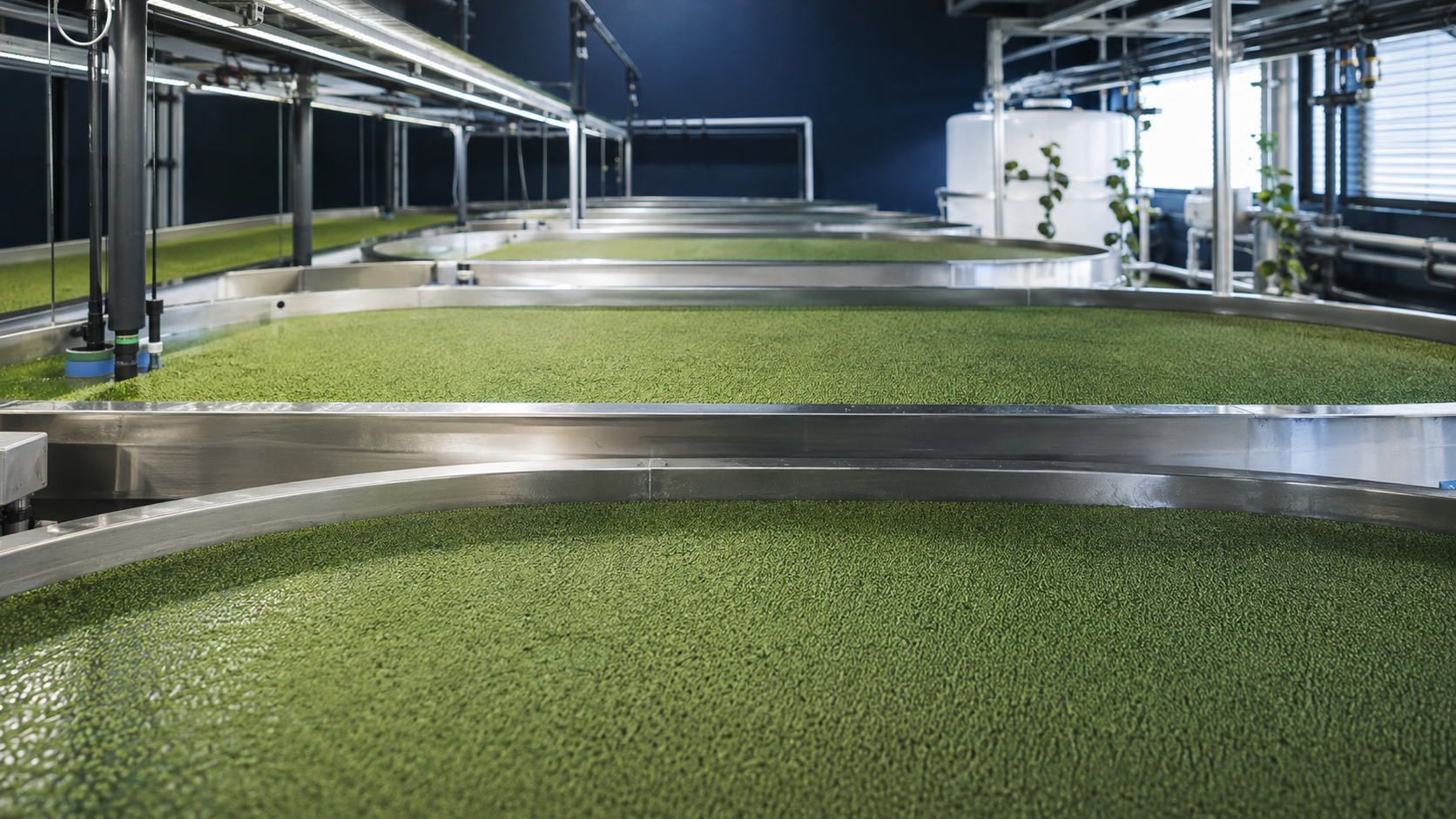
Wolffia floats and grows directly at the water surface, without conventional farmland. In controlled basins, water quality and nutrient supply can be adjusted and studied.
Using multiple levels
More cultivation area in the same space.
Shallow basins can be arranged in tiers, increasing cultivation area within the same footprint. The actual advantage depends on the design of the facility.
How Wolffia grows
Light becomes new plant biomass.
Wolffia uses light, carbon dioxide from the air and dissolved nutrients to grow. Controlled facilities allow these conditions and their effects to be studied.
Cultivation as a system
Six variables, one biological system.
No single parameter explains a successful culture. What matters is how the variables interact—and whether change is measured reliably.
Clone and origin influence growth and composition.
Quality, pH and ion profile define the immediate environment.
Availability and balance affect biomass and composition.
Intensity, spectrum and photoperiod drive photosynthesis.
Temperature and airflow shape metabolism and stability.
Timing and method affect quality and process performance.
Controlled environment
Measurable from culture water to harvest.
Controlled systems help distinguish biological effects from random environmental influences. Sensors, sampling and documented processes make development traceable.
- Defined starting culture
- Documented water and nutrient parameters
- Regular biomass and quality measurements
- Hygiene and contamination management
Selected literature
Evidence before promises.
Ruekaewma N., Piyatiratitivorakul S., Powtongsook S.
Songklanakarin Journal of Science and Technology 37(5), 575–580
Kultivierung, Protein und Aminosäuren.Appenroth K. J. et al.
Frontiers in Chemistry 6:483
Fettsäuren, Mineralstoffe und Carotinoide in vier Wolffia-globosa-Klonen.DOI 10.3389/fchem.2018.00483 ↗Sela I. et al.
Nutrients 12:3067
LC-MS/MS-Analyse biologisch aktiver B12-Formen; kein Pseudo-B12 in den untersuchten Proben.DOI 10.3390/nu12103067 ↗EFSA NDA Panel
EFSA Journal 19(12):6938
Analytische Daten zu Protein, Ballaststoffen, Fett, ALA, Vitaminen und Mineralstoffen.DOI 10.2903/j.efsa.2021.6938 ↗Mehrere Autoren
Journal of Food Composition and Analysis 135:106603
Hinweise auf Wolffia-assoziierte Mikroorganismen als Ursprung des Vitamins.DOI 10.1016/j.jfca.2024.106603 ↗EFSA NDA Panel
EFSA Journal
Kein spezifischer Referenzwert für ein „optimales“ n-3:n-6-Verhältnis.DOI 10.2903/j.efsa.2010.1461 ↗FAQ
Frequently asked questions about Wolffia
What is Wolffia globosa?
A rootless, free-floating flowering plant belonging to the arum family.
Is Wolffia an alga?
No. It is a highly reduced flowering plant.
How small is Wolffia?
Individual plants are generally around 0,4 to 0,8 millimetres long.
How fast can it grow?
Under suitable controlled conditions, biomass may double within a few days.
Does Wolffia contain vitamin B12?
Biologically active B12 forms have been found in certain controlled samples. This does not automatically apply to every culture.
How is Wolffia cultivated?
On water surfaces where light, temperature, water quality and nutrient supply can be controlled.
About the literature values shown
The composition and cultivation figures describe results from published Wolffia globosa research. They are not a specification for an AquaSphere product. Values may vary with clone, origin, nutrient medium, water composition, light, temperature, harvest, drying, processing and analytical method.